
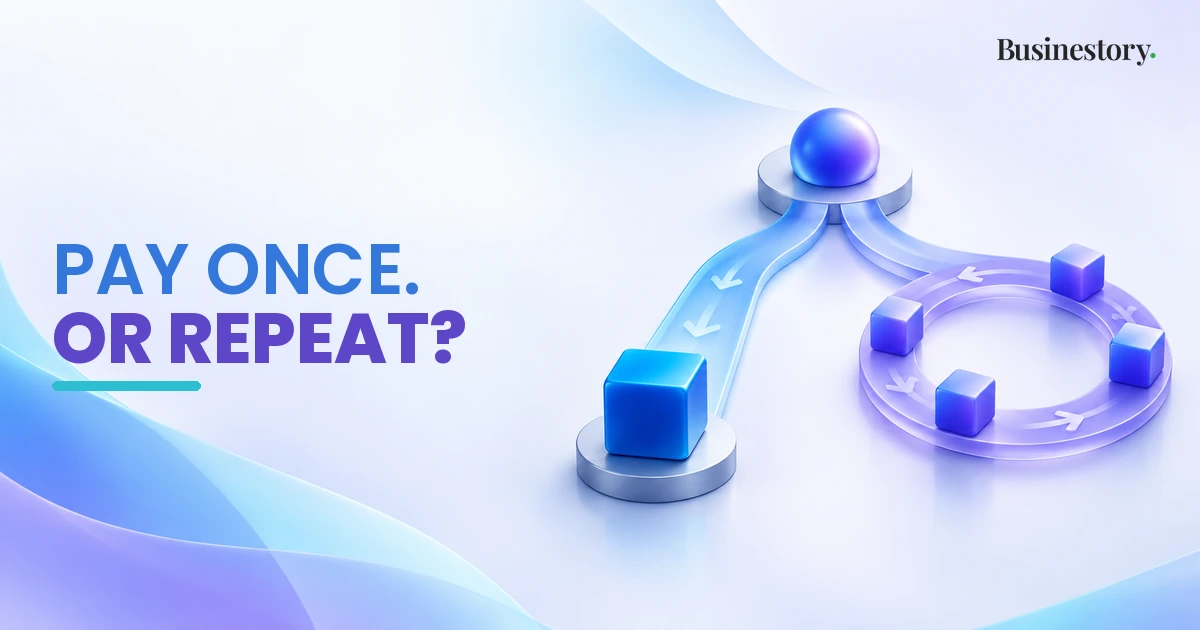
In today’s business world, companies earn money in different ways. Two common pricing models are the subscription model and the one-time payment model. You may have used both without thinking much about them.
For example, when you pay monthly for Netflix, that is a subscription. When you buy a phone from Apple and pay once, that is a one-time payment.
But which model is better?
The answer depends on the type of business, the product, and the customer’s needs. In this article, we will explain both models in simple English and compare them step by step.
Many SaaS companies rely heavily on subscription-based recurring revenue.
What Is a Subscription Model?
A subscription model means customers pay regularly — usually every month or every year — to keep using a product or service.
Instead of paying once and owning the product forever, customers continue paying as long as they want access.
Simple Examples
- Netflix – Monthly payment to watch movies and shows
- Spotify – Monthly payment to listen to music
- Microsoft (Microsoft 365) – Yearly or monthly payment for software
- Adobe (Creative Cloud) – Subscription for design tools
This model is very common in SaaS (Software as a Service) businesses. Instead of selling software once, companies charge users every month or year.
Why Subscription Models Became Popular
Subscription models became popular because:
- Customers like smaller, regular payments instead of one big payment.
- Companies get steady income every month.
- Businesses can update and improve products continuously.
- It builds long-term customer relationships.
What Is a One-Time Payment Model?
A one-time payment model means customers pay once to buy a product or service. After payment, they own it.
There is no recurring charge.
Simple Examples
- Buying a laptop from Dell
- Buying furniture from IKEA
- Purchasing a physical book
- Paying once to download certain software
Traditional businesses mostly use this model. You pay once, and the transaction is complete.
Revenue Stability: Which Model Is More Predictable?
Revenue stability means how predictable and consistent the company’s income is.
Subscription Model
Subscription businesses have stable and predictable revenue.
If 1,000 customers pay $10 per month, the company knows it will likely earn $10,000 next month (unless many customers cancel).
This predictability helps companies:
- Plan expenses
- Hire employees confidently
- Invest in growth
SaaS companies especially benefit from this steady income.
One-Time Payment Model
Revenue in this model is less predictable.
Sales may be high during some months and low during others. For example, product businesses may sell more during festival seasons and less during slow periods.
The company must continuously attract new buyers to maintain income.
Conclusion on Revenue Stability:
Subscription models generally offer more stable revenue.
Scalability: Which Model Grows More Easily?
Scalability means how easily a business can grow without increasing costs at the same speed.
Subscription Model
Digital subscription businesses scale very well.
For example, if a software company gains 10,000 new users, the cost increase may be small compared to revenue increase.
Cloud-based SaaS companies can serve thousands or millions of customers with limited additional cost.
This is why companies like Salesforce grew very large using subscriptions.
One-Time Payment Model
Physical product businesses often face higher costs when scaling:
- Manufacturing costs
- Storage
- Shipping
- Inventory management
Growth requires more resources.
However, digital products sold as one-time purchases (like an online course) can also scale well.
Conclusion on Scalability:
Subscription models, especially digital ones, often scale more smoothly and efficiently.
Customer Lifetime Value (CLV)
Customer Lifetime Value (CLV) means the total money a customer spends with a company over time.
Subscription Model
In subscription businesses, CLV can be very high.
Example:
If a customer pays $20 per month and stays for 3 years:
$20 × 36 months = $720
One customer can generate large long-term revenue.
This is why subscription businesses focus heavily on customer retention (keeping customers happy so they don’t cancel).
One-Time Payment Model
In this model, CLV depends on repeat purchases.
If a customer buys a product once for $200 and never returns, the CLV is $200.
To increase CLV, companies must:
- Introduce new products
- Encourage repeat purchases
- Offer upgrades
Without repeat buying, CLV stays limited.
Conclusion on CLV:
Subscription models usually create higher lifetime value per customer.
Customer Perspective: Which Feels Better?
It is important to look at both sides — business and customer.
Why Customers Like Subscriptions
- Lower upfront cost
- Access to updates and new features
- Flexibility to cancel
- Ongoing support
But some customers feel tired of “too many subscriptions.” Monthly payments can add up.
Why Customers Like One-Time Payments
- Clear ownership
- No recurring charges
- No need to worry about cancellation
However, the upfront cost can be high.
Real-World Business Comparison
SaaS Companies
Most SaaS companies prefer subscription models.
Examples:
- Zoom
- Dropbox
These companies provide continuous service, so recurring payment makes sense.
Product Businesses
Physical product companies often use one-time payments.
Examples:
- Nike
- Samsung
You buy shoes or a phone once. You do not pay monthly to keep wearing them.
Risks in Each Model
Risks of Subscription Model
- Customer churn (cancellation)
- Need for constant value delivery
- High competition
- Customers becoming subscription-fatigued
If customers cancel, revenue drops quickly.
Risks of One-Time Payment Model
- Revenue unpredictability
- Dependence on new customer acquisition
- Seasonal sales fluctuations
If new sales slow down, revenue declines immediately.
Which Model Is Better?
There is no universal answer. The best model depends on the situation.
Subscription Model Is Better When:
- The product delivers ongoing value
- Continuous updates are required
- Service is cloud-based or digital
- Customer relationship matters long-term
- Predictable revenue is important
This is why SaaS businesses strongly prefer subscriptions.
One-Time Payment Model Is Better When:
- The product is physical
- Ownership is important
- Value is delivered instantly
- Customers do not need ongoing service
For example, furniture or electronics often fit better with one-time payments.
Hybrid Models (Mix of Both)
Some businesses combine both models.
For example:
- Sell hardware once
- Charge subscription for software or services
Many smart device companies follow this approach.
This allows businesses to get upfront revenue and recurring income together.
Final Thoughts
Both subscription and one-time payment models have strengths and weaknesses.
Subscription models offer:
- Predictable revenue
- Higher customer lifetime value
- Strong scalability
But they require:
- Continuous value delivery
- Customer retention focus
One-time payment models offer:
- Simple transactions
- Clear ownership
- No ongoing commitment
But revenue may be less stable.
Instead of asking “Which is better?” a better question is:
Which model fits the product and customer behavior best?
If the product creates ongoing value and needs updates, subscription often works well.
If the product delivers full value at purchase and does not require ongoing support, one-time payment may be better.
In business, the right pricing model is not about trends. It is about alignment — between product, customer expectations, and long-term strategy.
Choosing the correct model can shape a company’s growth, stability, and relationship with its customers for years to come.
Choosing the right revenue model depends on long-term goals, not short-term profits.