
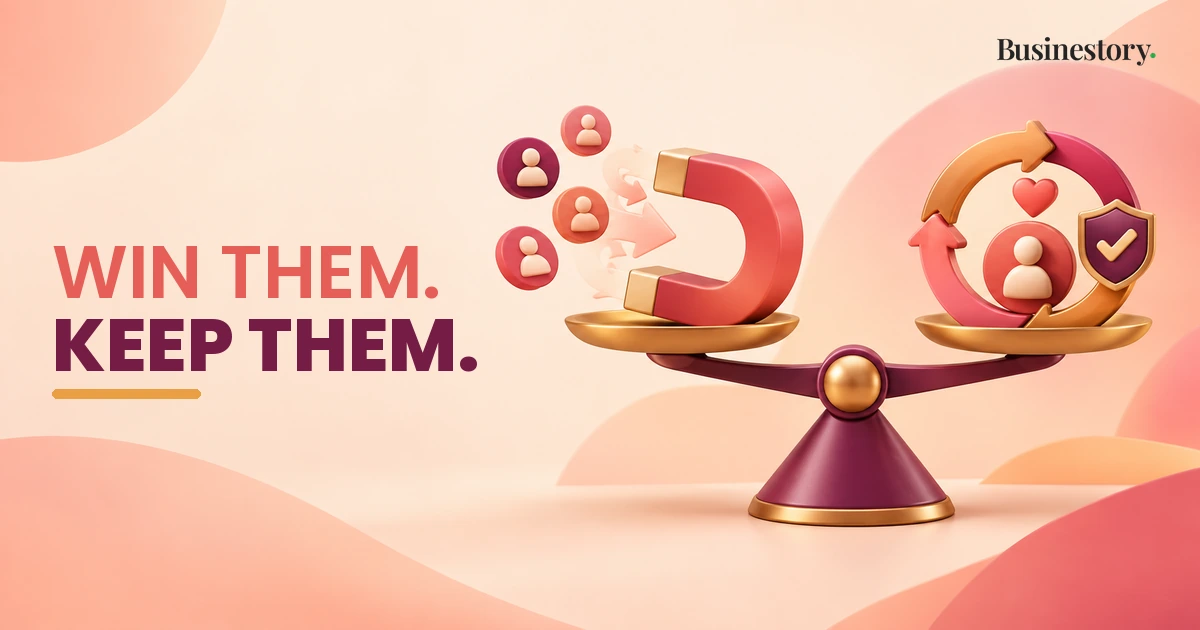
When you start or grow a business, one question often comes up:
Should you focus more on getting new customers or keeping the ones you already have?
This is the idea behind customer acquisition vs customer retention. Both are important, but they play different roles in a business. Understanding the difference can help you make better decisions and grow in a stable way.
Let’s explore both concepts in simple terms.
Many SaaS businesses focus heavily on retaining customers to build long-term revenue.
What Is Customer Acquisition?
Customer acquisition means bringing new customers into your business.
It includes all the activities you do to make people aware of your product and convince them to buy. This can happen through:
- Advertising (online or offline)
- Social media marketing
- Search engine optimization (SEO)
- Content marketing (blogs, videos)
- Sales calls or outreach
- Referral programs
For example, if someone sees your ad on Instagram and buys your product for the first time, that is customer acquisition.
Why Acquisition Matters
Without new customers, a business cannot grow. Every business needs a steady flow of new people who:
- Try the product
- Become paying customers
- Potentially become loyal users later
Acquisition is especially important in the early stages of a business, when you are trying to build awareness and reach.
What Is Customer Retention?
Customer retention means keeping your existing customers and encouraging them to continue buying from you.
Instead of focusing on new people, retention focuses on people who have already purchased from you.
Retention includes:
- Good customer service
- Email follow-ups
- Loyalty programs
- Product improvements
- Regular communication
- Subscription renewals
For example, if a customer buys from you again next month, that is customer retention.
Why Retention Matters
Retention helps businesses build long-term relationships with customers. Instead of making a sale once, you create repeat buyers.
This leads to:
- Stable revenue
- Higher lifetime value per customer
- Strong brand loyalty
In simple words, retention turns one-time buyers into regular customers.
Recurring revenue businesses depend on keeping customers for a long time.
The Cost Difference: Acquisition vs Retention
One of the most important differences between acquisition and retention is cost.
Customer Acquisition Is Expensive
Getting a new customer often costs more because:
- You need to spend on ads or marketing
- Many people may see your offer but not buy
- You have to build trust from zero
This is called Customer Acquisition Cost (CAC).
For example, if you spend ₹10,000 on ads and get 100 customers, your CAC is ₹100 per customer.
Customer Retention Is Cheaper
Keeping an existing customer is usually much cheaper because:
- They already trust your brand
- They already know your product
- You don’t need heavy marketing again
You might only need small efforts like emails or support.
Simple Insight
- Acquisition = high cost, high effort
- Retention = lower cost, higher efficiency
That’s why many businesses say:
“It is cheaper to keep a customer than to find a new one.”
Why Retention Is Powerful in SaaS and Subscription Businesses
Retention becomes even more important in subscription-based businesses like:
- Software (SaaS)
- Membership platforms
- Streaming services
- Subscription boxes
In these businesses, customers pay monthly or yearly.
How Retention Drives Revenue
Let’s say:
- A customer pays ₹500 per month
- They stay for 12 months
Total value = ₹6,000 from one customer
But if they leave after 2 months:
Total value = ₹1,000
This is a big difference.
Key Idea: Lifetime Value (LTV)
Retention increases Customer Lifetime Value (LTV) — the total money a customer spends over time.
- High retention = high LTV
- Low retention = low LTV
The Risk of Poor Retention
If customers leave quickly (called churn), the business must constantly spend money to get new users.
This creates pressure and reduces profits.
Simple Summary
For SaaS and subscriptions:
- Retention is not optional
- It is the core of the business model
Real-World Examples
Example 1: Food Delivery App
A food delivery app spends money on ads to bring in new users.
- First order → acquisition
- Repeat orders → retention
If users only order once, the company loses money.
If they order regularly, the company becomes profitable.
Example 2: Gym Membership
A gym signs up new members in January.
- New sign-ups → acquisition
- Members continuing after 3 months → retention
Many gyms depend heavily on retention because they earn monthly fees.
Example 3: Online Software Tool
A company sells a subscription tool for ₹1,000 per month.
- New signup → acquisition
- Monthly renewal → retention
If customers keep renewing, the business grows steadily.
Example 4: E-commerce Store
An online store attracts customers through ads.
- First purchase → acquisition
- Repeat purchase → retention
Brands that build loyalty (like through quality and service) grow faster because customers return.
Acquisition vs Retention: Key Differences
Here is a simple comparison:
| Factor | Customer Acquisition | Customer Retention |
|---|---|---|
| Focus | New customers | Existing customers |
| Cost | High | Lower |
| Effort | More marketing needed | Less marketing needed |
| Trust level | Low (new users) | High (existing users) |
| Revenue type | One-time initially | Repeat revenue |
| Risk | High (uncertain conversion) | Lower (known behavior) |
Both are important, but they serve different purposes.
Which Matters More?
The answer depends on the stage of the business.
Stage 1: Early Business (Startup Phase)
In the beginning, acquisition matters more.
Why?
- You need customers to test your product
- You need feedback
- You need initial revenue
At this stage:
- Focus on getting users
- Try different marketing channels
- Learn what works
However, ignoring retention completely is risky.
If people leave immediately, something is wrong with the product.
Stage 2: Growth Phase
Once you have some customers, both acquisition and retention become important.
At this stage:
- Continue bringing in new users
- Improve product experience
- Start building loyalty
This is where businesses begin to balance both sides.
Stage 3: Mature Business
In a mature stage, retention becomes more important.
Why?
- You already have many customers
- Growth comes from repeat usage
- Profit depends on long-term relationships
Companies at this stage focus on:
- Customer satisfaction
- Product improvements
- Reducing churn
A Simple Way to Think About It
- Acquisition brings customers in
- Retention keeps them inside
A business needs both.
But without retention, acquisition becomes wasteful.
Common Mistakes Businesses Make
1. Focusing Only on Acquisition
Some businesses spend heavily on ads but ignore customer experience.
Result:
- Customers leave quickly
- High costs, low profits
2. Ignoring Customer Feedback
Retention improves when businesses listen to customers.
Ignoring feedback leads to:
- Poor experience
- Higher churn
3. Not Measuring Key Metrics
Businesses should track:
- Customer Acquisition Cost (CAC)
- Customer Lifetime Value (LTV)
- Retention rate
- Churn rate
These numbers help in making better decisions.
Finding the Right Balance
Instead of choosing one over the other, businesses should aim for a balance.
A Healthy Approach
- Use acquisition to grow
- Use retention to sustain and profit
Think of it like this:
- Acquisition is like planting seeds
- Retention is like watering and growing them
Both are necessary for a strong business.
Final Thoughts
Customer acquisition and customer retention are both essential parts of a successful business.
- Acquisition helps you grow and reach new people
- Retention helps you build long-term value and stability
In the early stages, acquisition plays a bigger role.
As the business grows, retention becomes more important.
The most successful businesses understand this balance. They don’t just chase new customers—they also take care of the ones they already have.
In simple terms:
- Getting customers is important
- Keeping them is even more powerful
When both work together, a business can grow in a steady and sustainable way.
Understanding customer acquisition and retention helps explain how businesses grow sustainably over time.