
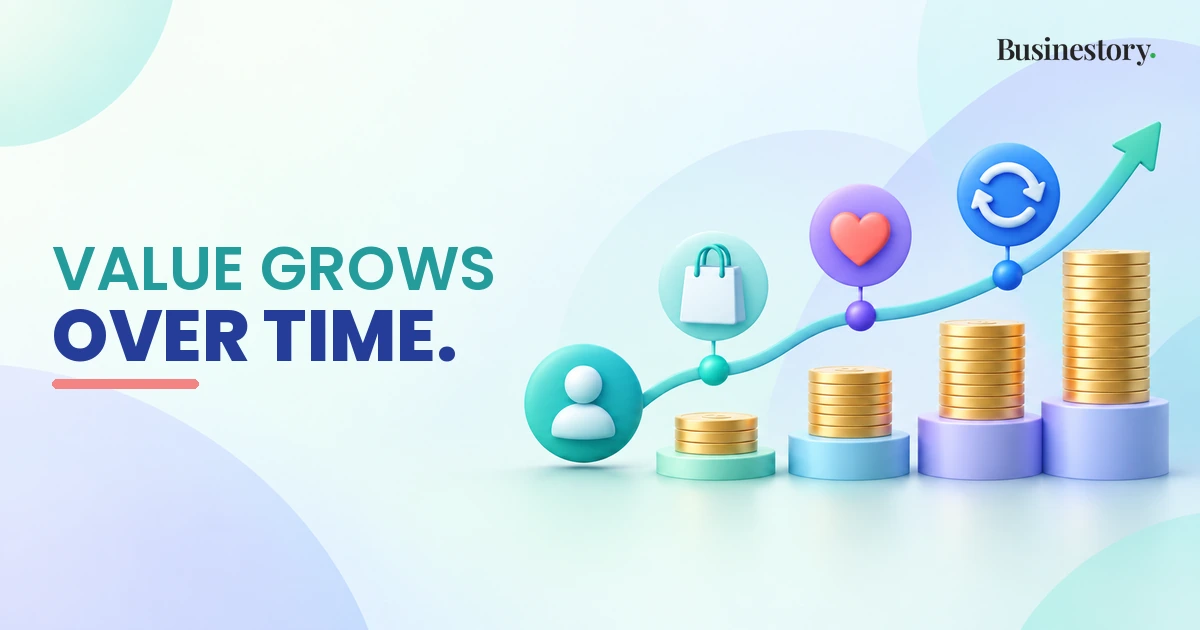
Customer Lifetime Value, often called LTV, is one of the most important ideas in business. It helps companies understand how much a customer is worth over time—not just from a single purchase, but across the entire relationship.
In this article, we’ll explain LTV in simple terms, why it matters, how to calculate it, and how it connects to profit and growth.
Understanding customer acquisition and retention is important before learning about lifetime value.
What Does Customer Lifetime Value Mean?
Customer Lifetime Value (LTV) is the total money a business expects to earn from one customer during the entire time they stay with the company.
Instead of thinking:
“How much did this customer spend today?”
LTV asks:
“How much will this customer spend over months or years?”
Simple way to understand:
If a customer buys from you again and again, their value increases over time.
Why LTV Is Important for Businesses
LTV is not just a number—it helps businesses make better decisions.
1. Helps Understand Customer Value
Not all customers are equal. Some buy once and leave. Others stay for years.
LTV helps businesses:
- Identify valuable customers
- Focus on long-term relationships
- Improve customer experience
2. Guides Marketing Spending
Businesses spend money to attract customers. But how much should they spend?
If you know LTV, you can answer:
- “Is it worth spending ₹500 to acquire this customer?”
- “Will we earn more than what we spend?”
3. Supports Long-Term Growth
Companies that focus on LTV:
- Build loyal customers
- Get repeat purchases
- Grow more steadily
Instead of chasing new customers all the time, they build stronger relationships.
Simple Example of LTV Calculation
Let’s keep this very basic—no complex math.
Example:
- A customer spends ₹1,000 per month
- They stay with the business for 12 months
LTV = Monthly spend × Number of months
LTV = ₹1,000 × 12 = ₹12,000
So, one customer is worth ₹12,000 over their lifetime.
Another Example (Retail):
- A customer buys products worth ₹2,000 per year
- They stay for 5 years
LTV = ₹2,000 × 5 = ₹10,000
Even if each purchase is small, long-term customers become very valuable.
What Affects Customer Lifetime Value?
LTV depends on a few key factors:
1. Purchase Frequency
How often does the customer buy?
- Frequent buyers → Higher LTV
- One-time buyers → Low LTV
2. Average Order Value
How much does the customer spend each time?
- Higher spending → Higher LTV
3. Customer Lifespan
How long does the customer stay with the business?
- Longer relationship → Higher LTV
4. Customer Experience
Good experience = customers stay longer.
- Fast support
- Quality product
- Smooth service
All these increase LTV.
Recurring revenue businesses often focus on increasing customer lifetime value over time.
LTV and Customer Acquisition Cost (CAC)
To understand LTV fully, we must also understand Customer Acquisition Cost (CAC).
What is CAC?
CAC is the cost of getting a new customer.
Example:
- Ads cost: ₹10,000
- Customers gained: 20
CAC = ₹10,000 ÷ 20 = ₹500 per customer
LTV vs CAC: Why It Matters
The relationship between LTV and CAC is very important.
Case 1: Good Situation
- LTV = ₹10,000
- CAC = ₹1,000
This is good because:
- You spend ₹1,000
- You earn ₹10,000
Profit is high.
Case 2: Bad Situation
- LTV = ₹2,000
- CAC = ₹1,500
This is risky because:
- Very little profit
- Hard to grow
Ideal Rule
Many businesses aim for:
LTV should be at least 3 times CAC
This means:
- Spend ₹1 → Earn ₹3
This creates a healthy business model.
How LTV Connects to Profit
Profit is not just about sales—it’s about long-term value.
Example:
Imagine two businesses:
Business A
- Gets many customers
- Customers buy only once
Business B
- Gets fewer customers
- Customers buy again and again
Even if Business A looks bigger, Business B can be more profitable because of higher LTV.
Key Insight
- High LTV = Strong business
- Low LTV = Weak customer retention
Why SaaS Businesses Focus Heavily on LTV
SaaS (Software as a Service) companies depend heavily on LTV.
Why?
Because SaaS works on subscriptions.
Customers pay:
- Monthly
- Yearly
Example:
A SaaS tool charges ₹500/month.
If a customer stays for 2 years:
LTV = ₹500 × 24 = ₹12,000
SaaS Strategy
SaaS companies:
- Spend more money to acquire customers
- Focus on keeping them longer
Because:
The longer the customer stays, the more profit they generate.
Key SaaS Focus Areas
- Reducing churn (customers leaving)
- Improving product quality
- Offering customer support
- Adding new features
All these increase LTV.
Real-World Examples of LTV
Let’s look at simple real-world cases.
1. E-commerce Store
A clothing brand notices:
- One-time buyers spend ₹1,000
- Repeat customers spend ₹5,000 over time
So they:
- Offer loyalty programs
- Send email offers
- Improve product quality
Goal: Turn one-time buyers into repeat customers.
2. Gym Membership
A gym charges ₹2,000/month.
- If a customer stays 1 month → LTV = ₹2,000
- If they stay 12 months → LTV = ₹24,000
The gym:
- Offers training support
- Keeps members engaged
Goal: Increase retention → Increase LTV
3. Streaming Services
Streaming platforms depend on subscriptions.
- Monthly fee: ₹199
- Average user stays 18 months
LTV = ₹199 × 18 = ₹3,582
They focus on:
- New content
- Personalized recommendations
So users stay longer.
4. Food Delivery Apps
Food delivery platforms track:
- Order frequency
- Average order value
They increase LTV by:
- Discounts
- Fast delivery
- Rewards
Goal: Make customers order more often.
How Businesses Can Increase LTV
Improving LTV is often easier than getting new customers.
1. Improve Customer Experience
Happy customers stay longer.
- Better service
- Faster delivery
- Easy returns
2. Encourage Repeat Purchases
- Email reminders
- Discounts
- Membership programs
3. Increase Average Order Value
- Bundle offers
- Upselling (suggest higher-value products)
- Cross-selling (related products)
4. Reduce Customer Churn
Churn = customers leaving.
To reduce churn:
- Solve problems quickly
- Keep customers engaged
- Provide consistent value
Common Mistakes About LTV
1. Focusing Only on New Customers
Many businesses spend too much on acquisition and ignore existing customers.
But:
Existing customers are often more valuable.
2. Ignoring Retention
If customers leave quickly:
- LTV drops
- Profit drops
Retention is key.
3. Overestimating LTV
Businesses sometimes assume customers will stay longer than they actually do.
This can lead to:
- Overspending on marketing
- Losses
Simple Summary
Customer Lifetime Value (LTV) answers one important question:
“How much is a customer worth to my business over time?”
Key points:
- LTV = total revenue from a customer
- Higher LTV = stronger business
- LTV depends on:
- Purchase frequency
- Spending amount
- Customer lifespan
Important Relationship:
- LTV should be much higher than CAC
- This ensures profit and growth
Final Thought
Businesses that succeed in the long run don’t just focus on selling once. They focus on building relationships.
When customers trust a brand and keep coming back, their lifetime value increases—and that becomes the foundation of a stable and profitable business.
If you want, I can next explain how to calculate LTV step-by-step using your own business numbers or connect it with your stock/market analysis thinking.
Understanding customer lifetime value helps explain how businesses grow profitably over the long term.