
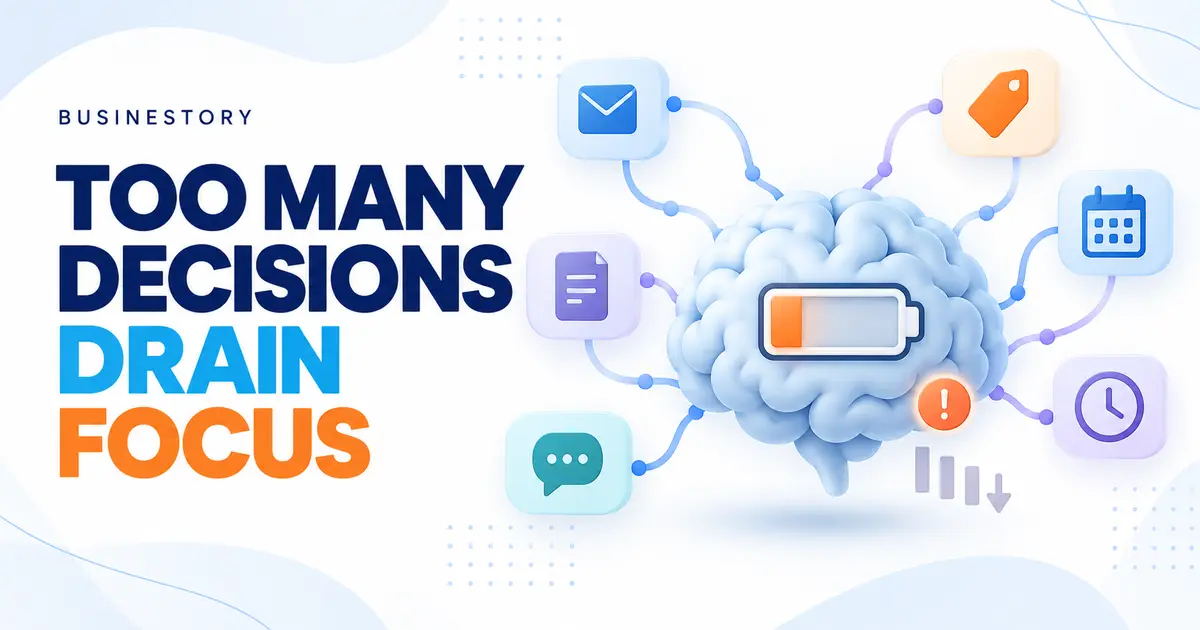
Running a small online business can look simple from the outside. Yet your mind may still feel crowded by the end of the day.
The reason is often not the size of the work. It is the number of decisions hidden inside it.
You decide what content to create, which email to answer first, which tool to use, whether to change a price, when to publish, and how to reply to a customer. Each choice seems small. Together, they make the business feel heavier than it appears.
Decision fatigue does not cause every difficult day. However, understanding it can help you remove avoidable mental work and save attention for choices that matter.
What Decision Fatigue Means
Decision fatigue is a useful term for the mental strain that can build after making many choices. As the strain increases, later decisions may feel harder. You may delay them, choose the easiest option, or respond less consistently than usual.
Research does not prove that everyone has a fixed daily supply of decision-making power. Sleep, stress, hunger, emotions, and the importance of a choice can affect judgment. Still, repeated choices can create mental load, especially when you switch between unrelated subjects.
Imagine answering customer messages while choosing a blog topic, checking a payment, comparing software, and considering a discount. None is enormous, but each asks your mind to understand a new situation and select an action.
That hidden work can slow you down.
It Is Not the Same as Overthinking or Tiredness
Decision fatigue, overthinking, low motivation, and physical tiredness can look similar, but they are not identical.
Decision fatigue appears after dealing with many choices. The problem is the accumulated demand of deciding.
Overthinking means spending too much time examining one decision, often without gaining useful clarity.
Lack of motivation means you do not feel willing or interested enough to act. You may understand exactly what to do but not want to begin.
Physical tiredness is a need for bodily rest or sleep. It can make decision-making worse, but it has a different main cause.
These conditions can overlap. A tired freelancer may overthink a reply after making many decisions. These labels simply help you notice what may be creating friction.
Decide Once With Default Decisions
A default decision is a choice you make once and reuse unless something important changes. It removes the need to reopen the same question every day.
For example, a blogger may choose Tuesday and Friday as fixed publishing days. A freelancer may use one invoice format. A service business may save replies to common questions. A designer may include two revision rounds. A digital product creator may reserve Friday afternoon for orders and support.
Defaults are starting points, not permanent laws. A special case can still receive a different response. Defaults stop ordinary work from demanding fresh judgment every time.
Reducing unnecessary choices can sometimes improve work more than trying to become more disciplined. Discipline matters, but routine tasks should not repeatedly ask, “What should I do now?”
Use Simple Rules for Repeated Situations
A decision rule connects a common situation to a planned response.
For example: “If a task takes less than five minutes, handle it during the admin block.” Another rule could be: “Do not buy a new tool unless the current tool cannot perform a required task.”
Other useful rules include:
- If a customer asks a common question, begin with the saved reply and personalise it.
- If a requested revision is outside the agreed scope, explain the extra cost before starting.
- If a purchase is not urgent, wait 48 hours before deciding.
Good rules reduce routine uncertainty while allowing sensible exceptions.
Having more options is not always better. Comparing twelve similar tools may create more friction than choosing among three suitable ones. Extra options consume time without always improving the result. Use a short requirements list to remove unsuitable choices before comparing.
Group Similar Decisions
Switching repeatedly between writing, customer support, finance, and design forces your mind to keep changing context. Batching means handling similar decisions together.
You might review routine emails at one time, approve several content ideas together, or check invoices in one sitting. This reduces how often your attention must move between different kinds of thinking.
Templates, checklists, SOPs, and recurring routines also help. A template provides a starting structure. A checklist shows what to check. An SOP records normal steps. A routine gives a task a familiar place.
Simple SOPs can reduce repeated operational decisions by giving routine tasks a clear set of steps.
These tools need not make a business rigid. They handle predictable work, leaving attention for judgment.
Protect Important Decisions
Changing your main offer, increasing a price, accepting a difficult project, or issuing a large refund may affect the business for months.
Avoid making such decisions after a long period of emails, record corrections, and minor requests. Record the issue, collect the facts, and return when your mind is calmer. A short delay is useful when it creates clarity, not endless avoidance.
A blogger may choose the next content direction before opening the inbox. A freelancer may review a complex project request before admin work. A digital product creator may examine refund patterns before changing the product. A service business may discuss an unusual complaint personally instead of forcing it through a standard reply.
Conduct a Simple Decision Audit
For one normal week, keep a note called “Decisions I Repeated.” Record choices that appeared more than once or interrupted your work.
At the end of the week, review the note and ask:
- Which decisions repeated most often?
- Which choices had the same answer almost every time?
- Which decisions interrupted focused work?
- Which choices required real judgment?
- Which decisions affected customers, money, or long-term direction?
Then place each repeated decision into one of four groups.
Automate decisions when a reliable tool can handle a clear, low-risk action, such as sending a payment confirmation.
Standardise decisions when the answer is predictable, such as an invoice layout, revision policy, file-naming method, or basic support reply.
Schedule decisions that need your attention but not immediately, such as reviewing expenses or selecting next month’s promotion.
Handle decisions personally when context matters, such as a customer problem, unusual refund, major price change, partnership, or new direction.
A Step-by-Step Way to Reduce Unnecessary Decisions
First, complete the decision audit and circle the three choices that repeat most often.
Second, ask whether each choice truly needs a new answer every time. If not, create a default, simple rule, template, or fixed review time.
Third, reduce the available options. Keep only the tools, channels, or formats that meet your current needs.
Fourth, group similar small decisions into one period to protect focused work from interruption.
Fifth, identify decisions with financial, customer, or strategic consequences. Give them separate time and the facts needed for a careful choice.
Sixth, test the changes for two weeks. Keep what saves time and reduces inconsistency. Adjust rules that create problems.
Finally, keep exceptions possible. A system should support judgment, not replace it.
Final Thoughts
Decision fatigue does not explain every mistake or slow day. The real problem may be missing information, poor sleep, too much work, or a genuinely difficult task.
A small online business often contains more decisions than its owner notices. Repeated ordinary choices use attention that could be spent on customers, creative work, and important changes.
You do not need to remove every decision. Decide routine matters once, group similar choices, and protect time for situations that deserve personal judgment. A simpler decision environment will not run the business for you, but it can make thoughtful action easier.