
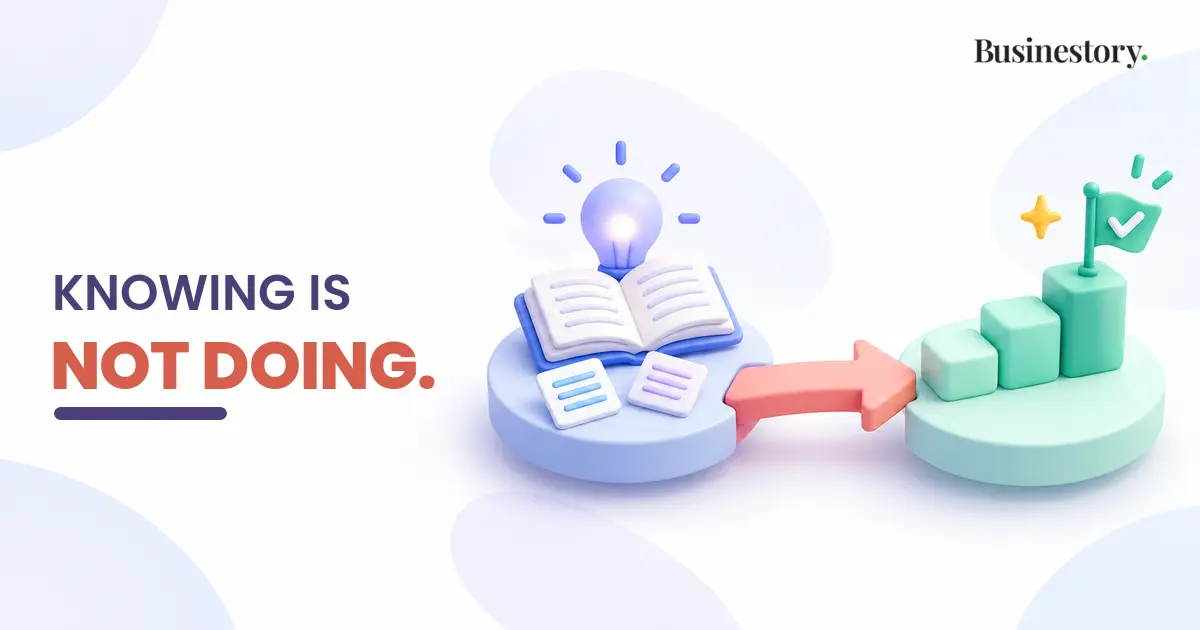
Many people believe that learning is the most important step toward success. They buy books, watch YouTube videos, read blogs, listen to podcasts, and join online communities. Learning is valuable because it helps us understand new ideas and avoid common mistakes.
However, there is one problem that stops many beginners from making real progress.
They keep learning but never start doing.
Months pass, and they know much more than when they began. They can explain many concepts, recommend useful tools, and even teach basic ideas to others. Yet, they still have not built a website, created content, launched a project, or completed their first real task.
Learning is important, but learning without action rarely creates results.
Let’s understand why.
Learning one skill deeply becomes valuable only when you start applying it in real situations.
Learning Is Only the First Step
Imagine someone who wants to learn how to ride a bicycle.
They read ten books about balancing.
They watch hundreds of riding videos.
They understand how brakes work.
They know every part of the bicycle.
But they never actually sit on one.
Will they know how to ride?
Of course not.
The same principle applies to almost every skill.
Reading teaches theory.
Practice teaches ability.
Both are useful, but theory alone cannot replace real experience.
Information Is Not the Same as Skill
Today, information is available everywhere.
A beginner can learn web design, programming, writing, video editing, marketing, photography, or almost any other skill without spending much money.
This is a great opportunity.
But information itself is not a skill.
Watching a cooking video does not make someone a good cook.
Reading about swimming does not teach someone how to swim.
Similarly, reading about building an online business does not create an online business.
A skill develops only when knowledge is used repeatedly in real situations.
Consuming Information vs Applying Information
There is a big difference between consuming information and applying it.
Consuming information means:
- Reading articles
- Watching tutorials
- Listening to podcasts
- Saving useful videos
- Taking notes
These activities help you understand ideas.
Applying information means:
- Building something
- Writing something
- Designing something
- Creating content
- Solving real problems
- Practicing repeatedly
This is where learning becomes useful.
Many beginners spend almost all their time consuming information and very little time applying it.
As a result, they feel busy but make little visible progress.
Knowledge Alone Does Not Create Income
Many beginners think that collecting more knowledge will automatically lead to earning money.
Unfortunately, it does not work that way.
A person may know everything about graphic design but never create a single design for a client.
Someone may understand affiliate marketing but never publish a website.
Another person may study programming for years but never build an application.
Knowledge creates possibilities.
Action creates results.
People are usually rewarded for the value they create, not for the information they have collected.
This is why practical work matters so much.
Experience Is Built Through Action
Every action teaches something that books cannot.
When you write your first article, you discover how difficult it is to organize ideas clearly.
When you edit your first video, you notice mistakes that tutorials never mentioned.
When you create your first website, you learn how different tools actually work together.
These lessons come from experience.
Experience cannot be downloaded.
It cannot be memorized.
It must be earned by doing the work.
This is why beginners often improve much faster after they start practicing regularly.
Experience Leads to Improvement
The first attempt is rarely perfect.
The second becomes a little better.
The tenth becomes easier.
The fiftieth often looks much more professional than the first.
Improvement happens because each attempt teaches something new.
You notice mistakes.
You find better methods.
You become faster.
You solve problems more easily.
Without action, these improvements never happen because there is nothing to improve.
Learning gives direction.
Practice creates progress.
Should Beginners Learn Free or Paid Online Courses?
Learn While Doing
One of the best ways to learn is to combine learning with action.
Instead of spending three months studying before starting, begin working on a small project immediately.
For example, imagine someone wants to become a content writer.
They could spend months reading about writing techniques.
Or they could read one article about writing today and then write their own article immediately afterward.
While writing, they will discover questions they never thought about before.
Now their future learning becomes much more meaningful because it solves real problems they have already experienced.
Learning and doing work best together.
Practical Example: Building a Website
Suppose a beginner wants to build a simple website.
One approach is spending weeks watching website tutorials.
Another approach is:
- Watch one beginner lesson.
- Create one page.
- Watch another lesson.
- Improve the page.
- Learn how to add images.
- Add images immediately.
- Learn basic SEO.
- Apply basic SEO to the page.
Each lesson is followed by immediate action.
Instead of collecting information, the beginner builds something real.
At the end of several weeks, they not only understand websites but also have one they created themselves.
Practical Example: Learning Video Editing
Imagine someone learning video editing.
They could watch fifty editing tutorials before opening editing software.
Or they could choose one short video and edit it today.
During editing, they will naturally learn about trimming, transitions, audio, subtitles, and exporting.
Whenever they face a problem, they search only for that specific solution.
This creates focused learning.
The knowledge is immediately used, making it much easier to remember.
Small Actions Create Big Progress
Many people underestimate small actions because they seem too simple.
Writing one paragraph.
Creating one design.
Recording one short video.
Publishing one blog post.
Fixing one small mistake.
These actions may appear insignificant on a single day.
But repeated consistently, they create impressive results over time.
A person who practices a little every day often progresses much faster than someone who studies for hours but rarely creates anything.
Small actions build momentum naturally.
Learning Becomes Clearer After Practice
An interesting thing happens once you begin working.
Concepts that once seemed confusing suddenly become easier to understand.
Why?
Because you now have context.
For example, reading about search engine optimization (SEO) feels abstract if you have never published a website.
But after publishing several pages, SEO advice becomes much easier to understand because you can connect it to your own experience.
Practice gives meaning to theory.
Without practice, many ideas remain difficult to fully understand.
Accept That Early Work Is Part of Learning
Beginners sometimes believe their first project should look professional.
This expectation often slows progress.
In reality, early work is part of the learning process.
The first article may contain mistakes.
The first website may look simple.
The first video may not be perfect.
That is completely normal.
Each project becomes a lesson that improves the next one.
The goal is not perfection.
The goal is steady improvement through consistent practice.
Build a Simple Learning Routine
A balanced routine can help beginners avoid spending all their time learning.
For example:
- Spend 30 minutes learning one new concept.
- Spend one or two hours applying that concept.
- Review what worked.
- Identify one improvement for tomorrow.
- Repeat the process regularly.
This simple cycle keeps learning connected to real work.
Instead of collecting endless information, you gradually build both knowledge and experience together.
Small actions taken consistently often create more progress than collecting more information.
Final Thoughts
Learning is one of the best investments you can make in yourself. It opens new opportunities, helps you understand valuable skills, and prepares you to solve problems more effectively.
But learning alone is never the finish line.
Real progress begins when knowledge is put into action.
Every small project, every completed task, and every practical attempt teaches lessons that books and videos cannot fully provide.
Knowledge gives you direction.
Action creates experience.
Experience creates improvement.
And steady improvement, repeated over time, is what eventually leads to meaningful results.
If you want your learning to make a difference, do not wait until you know everything.
Learn a little, apply a little, improve a little, and repeat.
That simple habit will take you much further than endless studying without action.
Knowledge becomes valuable only when it is applied. Small actions today are often worth more than perfect plans for tomorrow.