
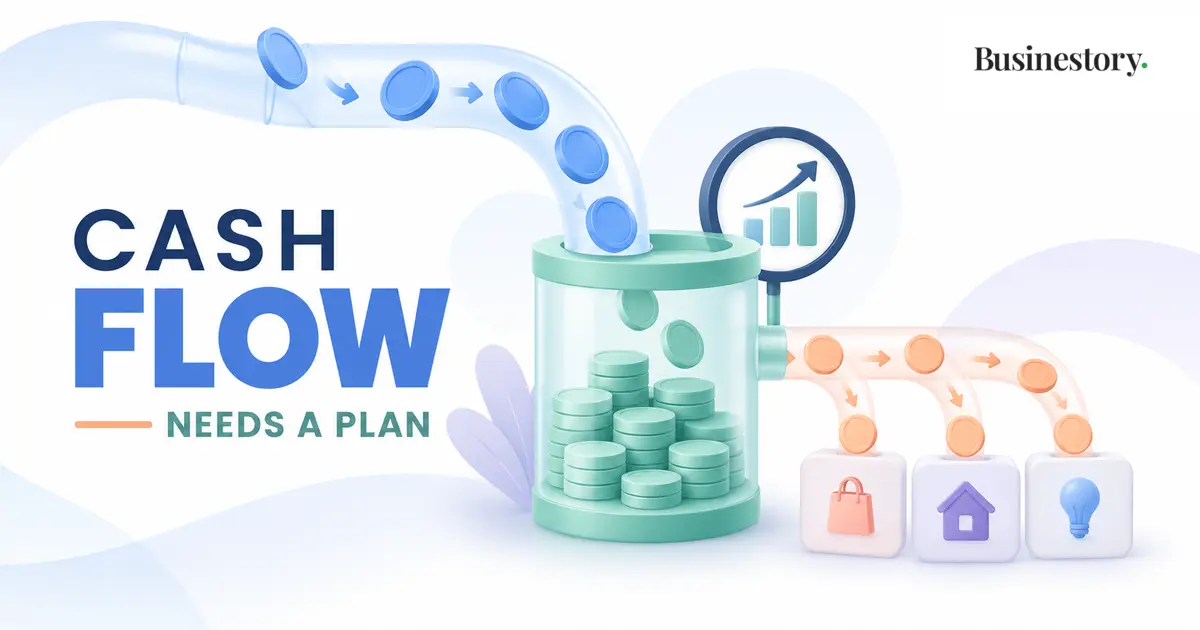
Making sales is important, but sales alone do not keep a business running. It also needs enough money available at the right time to pay expenses. This movement of money is called cash flow.
The idea is simple: money comes into your business, and money goes out. Managing cash flow means knowing whether enough will remain for upcoming needs.
What Cash Flow Means
Cash coming in is money your business actually receives. It may include customer payments, deposits, product sales, service payments, and affiliate income.
Cash going out is money the business spends. Examples include email services, software subscriptions, website hosting, domain renewals, advertising, payment fees, contractors, and other operating expenses.
Positive cash flow means more came in than went out. Negative cash flow means the opposite. One negative month does not always mean failure, but repeated shortages need attention.
Earned, Received, and Available Money
Money earned, money received, and money available to spend are not always the same.
Money is earned when you make a sale or complete customer work. It is received when payment reaches your account. Money available to spend is what remains after allowing for fees, bills, applicable taxes, and other commitments.
Suppose a freelancer finishes a $500 project and sends an invoice. The money has been earned but not received. After the customer pays, $200 may still be needed for contractors, subscriptions, and other obligations. Therefore, the full $500 is not freely available.
Understanding this difference prevents many beginner mistakes.
Why Sales Do Not Always Prevent Cash Problems
A business can make sales and still struggle to pay bills. This usually happens because the timing of income and expenses does not match.
For example, a service business may complete three projects now, while customers pay 15 or 30 days later. Website and contractor costs may be due today. Sales look good, but the needed cash has not arrived.
An invoice is a payment request, not cash in the bank. A delay affects cash flow even after the work and invoice are complete. Note expected dates and follow up professionally when payment is overdue.
Know What Is Coming and When
Cash-flow management becomes easier when you can see the timing of both income and expenses.
List expected payments and their likely dates. Then list regular expenses and due dates. A yearly domain, hosting plan, or software renewal can create a surprise if forgotten.
A customer may pay late, an affiliate platform may have a payout threshold, or a payment service may take days to transfer funds. Use realistic dates instead of assuming immediate payment.
Do Not Spend Every Payment Immediately
Receiving a large payment can make the business account appear healthier than it really is. Before spending it, check which bills and work-related costs are approaching.
Divide incoming money into simple purposes. One part may cover current expenses. Another can be held for upcoming commitments, applicable taxes, or a buffer. Only then consider what remains for other uses.
A business buffer is money kept for slow months, late payments, unexpected fees, or renewals. Build it gradually by keeping a manageable part of each payment.
Review Recurring Costs
Subscriptions are easy to start and easy to forget. A business may continue paying for an email tool, design app, scheduling service, analytics product, or premium plugin that is rarely used.
Review these costs regularly. Ask whether each tool supports current work and whether a cheaper plan would be enough. Cancel tools that no longer provide value. Several small savings can improve cash flow.
Do not remove a useful tool only because it costs money. The goal is to remove waste, not to make the business harder to operate.
Deposits and Advance Payments
For some service businesses, a deposit or advance payment can cover work-related costs. A designer, for example, may request an agreed deposit before a large project to help cover approved materials, contractor support, or reserved time.
This may not suit every situation. Deposits should be clearly agreed and used only when appropriate. Local rules and platform terms may also apply.
Practical Examples
A freelancer may earn well but experience a shortage when several clients pay late. Tracking expected dates and asking for suitable deposits on larger projects may reduce the gap.
A digital product creator may receive many launch payments, then little the next month. Keeping some income for future software and advertising makes the quieter period easier.
A blogger may see affiliate earnings in a dashboard but wait weeks before receiving a payout. Those pending earnings should not be treated as cash already available.
A service business collecting money before paying a contractor should know the due date and avoid using committed cash elsewhere.
A Simple Monthly Cash-Flow Example
Imagine a small online business receives the following during one month:
- Customer and product payments received: $1,400
- Affiliate income received: $100
- Total money received: $1,500
During the same month, it spends:
- Website and email tools: $120
- Advertising: $200
- Payment fees: $60
- Contractor and other operating costs: $420
- Total money spent: $800
The remaining amount is $700: $1,500 received minus $800 spent. This does not automatically mean all $700 can be used personally. Some may need to remain for next month’s bills, expected obligations, a buffer, or taxes where applicable.
A Simple Cash-Flow Routine
Beginners can use this weekly or monthly routine:
- Check the actual balance in each business payment or bank account.
- Record the money that was actually received during the period.
- List expected payments and the dates they are likely to arrive.
- Record money spent and list bills due soon.
- Compare available cash with upcoming expenses.
- Follow up on delayed customer payments when necessary.
- Review recurring subscriptions and cancel unnecessary ones.
- Keep an affordable amount aside as a business buffer.
- Repeat the review on the same day each week or month.
Use a simple spreadsheet, notebook, or basic financial tool. Consistency matters more than the method.
Common Cash-Flow Mistakes
One common mistake is confusing sales with available cash. A sale that has not been paid cannot cover today’s expense.
Another mistake is forgetting upcoming bills, especially annual charges. Spending all incoming money makes this worse and leaves no protection against a slow month.
Unnecessary subscriptions may each appear small, but together they can consume meaningful monthly income.
Ignoring payment delays is also risky. Late payments may force the business to postpone an expense or use its buffer.
Some owners review cash flow only when money becomes tight. Regular reviews provide time to reduce costs, delay optional spending, or follow up on payments.
Clear invoices can also help customers understand the amount owed and when payment is due.
Final Thoughts
Cash-flow management is not about perfect predictions. It means understanding what has arrived, what must be paid, and what can safely remain available.
Watch the timing of income and expenses, avoid spending every payment, remove wasteful subscriptions, and slowly build a buffer. These habits make late payments and uneven months easier to handle.
Tax, accounting, banking, and financial requirements vary by country and business structure. Beginners should check the rules that apply to their situation and seek qualified professional help when necessary. This article provides general education, not detailed accounting, tax, investment, or legal advice.
Cash flow does not need to be complicated. Know what money is coming in, what must go out, and what needs to remain available for the business to keep running.