
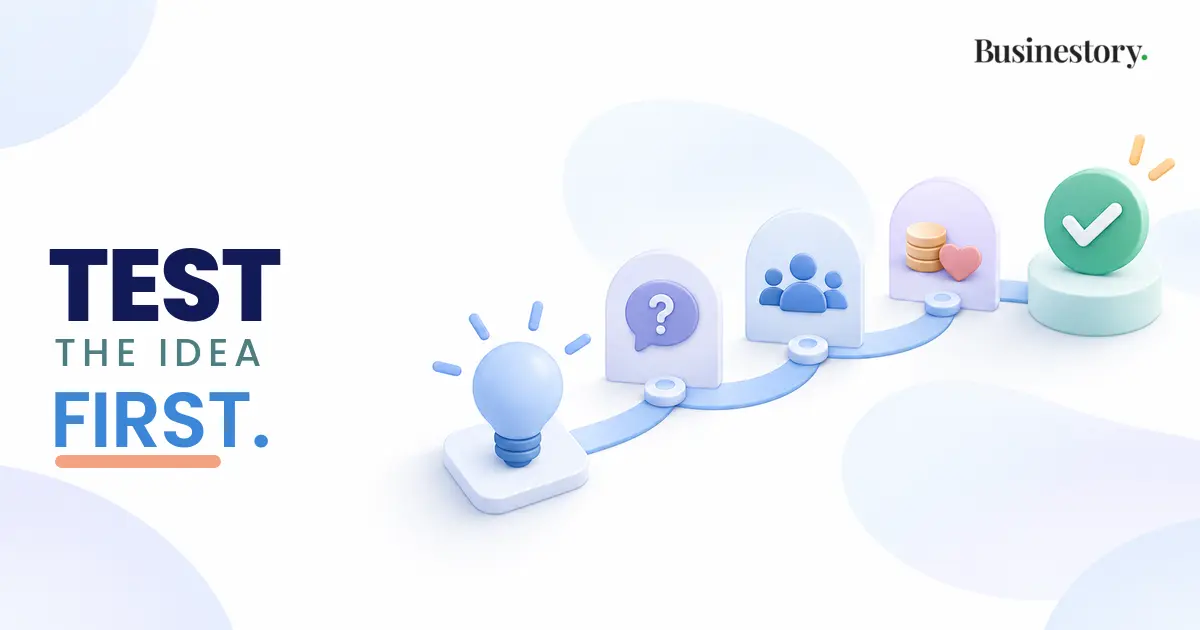
Many people come up with exciting online business ideas. They imagine the website, the products, the customers, and the future income. Then they spend weeks or even months building everything.
Only after launching do they discover that almost nobody is interested.
This happens more often than many beginners expect. The problem is not always the idea itself. The problem is spending too much time building before checking whether people actually want it.
Testing an online business idea does not require a large budget or a complete website. In many cases, you can learn valuable information with simple, low-risk experiments.
In this article, you will learn how beginners can test an online business idea before investing too much time, helping them make smarter decisions and avoid unnecessary work.
Before choosing any tool, make sure your online business idea is worth pursuing.
Why Many Beginners Build Before They Test
When people feel excited about an idea, they naturally want to start creating.
They buy a domain name, design a website, create logos, write long pages, and sometimes even develop products before knowing whether there is real demand.
The assumption is often:
“If I build it, people will come.”
Unfortunately, that is not how most businesses work.
An idea that sounds interesting to you may not solve a problem that enough people care about.
Instead of spending six months building first, it is often better to spend a few weeks testing whether people show genuine interest.
Testing does not guarantee success, but it helps you avoid investing months into an idea that has very little demand.
What Does Testing Really Mean?
Testing an idea simply means collecting evidence before making a big commitment.
Instead of asking yourself,
“Do I like this idea?”
you ask,
“Do other people seem interested in this idea?”
The goal is not to prove that your idea is perfect.
The goal is to learn whether it deserves more time and effort.
Think of testing as gathering information before making a long-term decision.
Start With Small Experiments
Many beginners believe testing requires a finished product.
It does not.
Small experiments are often enough to show whether people respond positively.
For example, instead of creating an entire online course, you could first publish several helpful articles or videos on the topic.
Instead of building a complete online store, you could create one simple page explaining your product idea.
These small experiments require much less time while still providing useful feedback.
If people show interest, you can continue building.
If they do not, you can improve the idea or move on without losing months of work.
Create Simple Content Around the Idea
One of the easiest ways to test an idea is by creating useful content.
Suppose you want to start a website about home gardening.
Before building a large website, write several helpful blog articles or create a few short videos.
Watch how people respond.
Do readers spend time on the content?
Do they leave comments?
Do they ask questions?
Do they share your content?
These reactions show whether people care about the topic.
Content testing also helps you understand which specific subjects attract the most attention.
Sometimes your original idea changes because your audience responds more strongly to one particular area.
Talk to Potential Customers
Many beginners skip one of the most valuable testing methods: having conversations.
If your business aims to solve a problem, talk to people who have that problem.
Ask simple questions like:
- What is your biggest challenge?
- How do you currently solve it?
- What do you wish was easier?
- Have you paid for a solution before?
Notice that these questions focus on learning, not selling.
You are trying to understand real experiences.
For example, if you plan to create a budgeting app, speak with people who are trying to manage their personal finances.
Their answers may reveal problems you never considered.
Sometimes these conversations completely reshape the original idea in a positive way.
Check Search Interest
Another useful method is checking whether people are actively searching for your topic.
If thousands of people search for information related to your idea every month, that usually indicates ongoing interest.
You can use free tools like Google Trends or keyword research tools to explore search activity.
Look for questions people ask repeatedly.
Notice whether interest stays consistent over time or disappears after a short trend.
For example, if you are thinking about creating content on healthy meal planning, search for related topics.
You may discover that certain questions receive far more attention than others.
This information helps you focus your efforts where people are already looking for answers.
Search interest alone does not guarantee success, but it provides another useful piece of evidence.
Learning a tool becomes valuable only when you actually use it.
Build a Simple Landing Page
You do not need a full website to test an idea.
A single landing page is often enough.
A landing page simply explains:
- What the idea is
- Who it helps
- Why it is useful
- What visitors should do next
For example, visitors might:
- Join an email list
- Request more information
- Sign up for updates
- Download a free guide
If nobody joins the email list after many visitors see the page, it may suggest that the message needs improvement or that interest is lower than expected.
If many people willingly leave their email addresses, that is a positive signal worth exploring further.
The landing page acts like a small experiment instead of a major investment.
Pay Attention to Real Feedback
Not all feedback is equally valuable.
Friends and family often say,
“That sounds like a great idea.”
While encouraging, this type of feedback may not help you make business decisions.
Instead, pay attention to actions.
Some useful signals include:
- People subscribe to your email list.
- Visitors return to your content.
- Readers ask detailed questions.
- People share your articles or videos.
- Someone asks when your product will be available.
- A few people are even willing to pay early.
These actions usually provide stronger evidence than compliments alone.
People often support ideas they genuinely find useful by taking some kind of action.
Run Several Small Tests
One experiment rarely tells the full story.
Instead of relying on one result, combine different testing methods.
For example:
Week 1:
Publish three helpful blog posts.
Week 2:
Talk with ten potential customers.
Week 3:
Create a simple landing page.
Week 4:
Share the page in relevant online communities and observe the response.
Each small test adds another piece of information.
Together, these results create a much clearer picture than relying on a single opinion.
A Simple Step-by-Step Validation Process
If you are completely new, you can follow this simple process.
Step 1: Clearly describe your idea in one sentence.
Keep it simple and specific.
Step 2: Create several pieces of useful content related to the topic.
Observe which topics attract the most attention.
Step 3: Speak with potential customers.
Listen more than you talk.
Look for repeated problems and common questions.
Step 4: Check whether people actively search for your topic online.
Look for consistent interest rather than temporary spikes.
Step 5: Build a basic landing page explaining your idea.
Invite visitors to join an email list or request updates.
Step 6: Collect feedback from all these activities.
Look for patterns instead of focusing on one positive or negative comment.
Step 7: Decide whether to continue, improve the idea, or test a different direction.
Following these steps requires much less time than building a complete business immediately.
A Practical Example
Imagine someone wants to build a website that teaches people how to grow vegetables in small apartments.
Instead of spending six months creating hundreds of articles, they decide to test the idea first.
They publish five beginner-friendly blog posts about balcony gardening.
Next, they create several short videos showing simple gardening tips.
They ask apartment owners about the biggest challenges they face when growing plants indoors.
They check search interest and notice that many people search for topics like “best vegetables for balconies” and “indoor gardening for beginners.”
Then they build a simple landing page offering a free beginner gardening guide in exchange for an email address.
Within a few weeks, they collect several hundred email subscribers and receive many questions from readers.
These results suggest that people are genuinely interested.
Now they can confidently spend more time creating additional content because they have real evidence that the topic attracts attention.
Don’t buy a tool just because it’s popular. First, decide whether you really need a paid solution.
Testing Saves Time in the Long Run
Some beginners believe testing delays progress.
In reality, testing often speeds it up.
Without testing, you may spend months building something that attracts very little interest.
With testing, you learn much earlier whether your direction makes sense.
Even if the results are disappointing, you have only invested a small amount of time.
You can improve the idea, change your approach, or explore another opportunity without feeling that months of work were wasted.
This makes learning faster and decisions more informed.
Final Thoughts
Every successful online business starts with an idea, but not every idea deserves months of work from the beginning.
Testing helps you replace assumptions with evidence.
Simple content, conversations with potential customers, search interest, and a basic landing page can reveal valuable insights before you invest heavily.
You do not need expensive tools or a finished business to begin testing. Small experiments are often enough to show whether people are interested and where improvements are needed.
By validating your idea step by step, you reduce unnecessary risk, save valuable time, and build your business on real feedback rather than guesswork. This practical approach gives beginners a stronger foundation for making informed decisions and moving forward with greater clarity.
The best tool is not the one with the most features. It is the one that helps you take consistent action and move your business forward.