
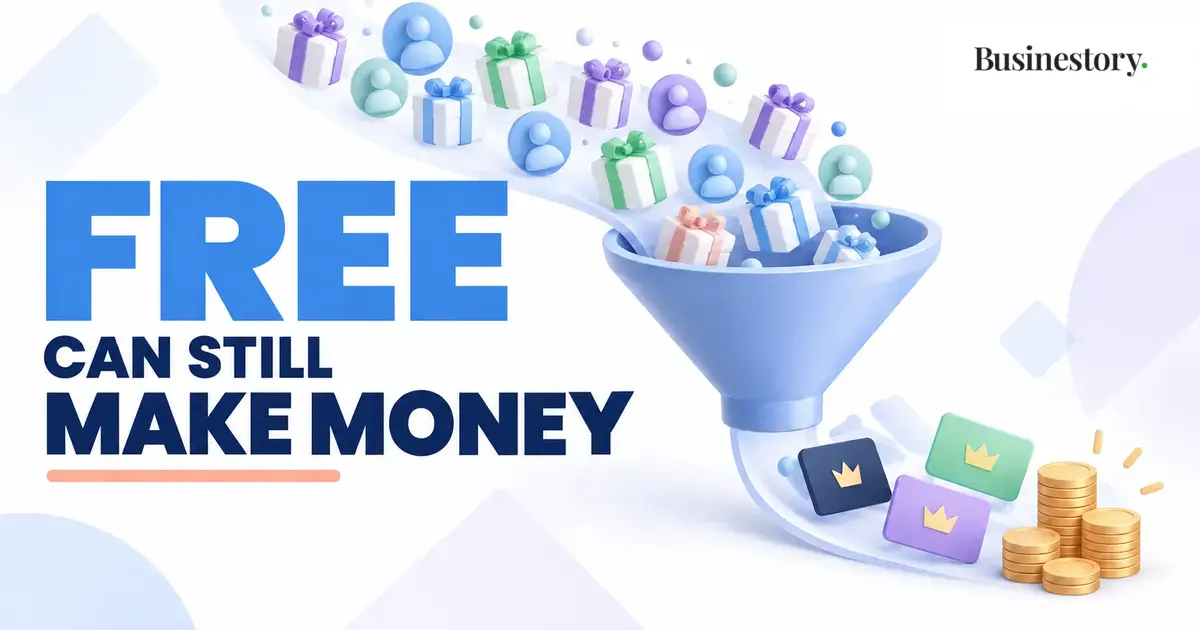
Many beginners ask: if a company gives something useful away for free, how can the business make money?
“Free” is sometimes a deliberately designed part of a business model. It is not necessarily a mistake or purely an act of generosity. A free offer may attract users, build trust, encourage sharing, or lead suitable customers toward a paid option.
The person using a free product is not always the person directly generating revenue. A user may view advertisements, invite others, create community activity, or help a platform attract paying customers.
Free access works only when the business understands its purpose, cost, and path to revenue.
Different Meanings of “Free”
Several offers may look free, but they work differently.
A free product has no required payment and may remain free permanently. The business needs another revenue source or strategic reason for providing it.
A free trial gives temporary access to a paid product. For example, a user may receive full access for 14 days, then pay to continue.
Freemium combines a permanent free version with paid versions. Free access usually has limits. Paid plans may provide advanced features, more capacity, greater convenience, support, or business use.
A lead magnet is a useful resource offered in exchange for contact information. It may be a checklist, guide, template, or short course designed to begin a relationship with a possible customer.
An ad-supported service lets people use content or features without paying directly. Advertisers pay the business to reach part of that audience.
Free audience-building content includes blog posts, videos, podcasts, and newsletters. It attracts people through useful information and may later introduce paid products or services.
Each method needs a clear connection between free value and business value.
Why Freemium Can Work
In a freemium business, many people may use the free version while only a small percentage pays. Paying users may want advanced tools, more storage, higher limits, fewer restrictions, faster support, team access, or commercial rights.
The percentage of free users who become paying customers is the conversion rate. If 1,000 people use a free plan and 30 become customers, the conversion rate is 3%.
That number alone does not show whether the model works. The company must compare revenue from paying customers with the cost of serving everyone.
A useful free version helps people experience an unfamiliar product without financial risk. A zero price can make the decision to try it easier. This reduces friction, but it does not guarantee future payment.
Balance is important. The free version must be useful enough to attract people, yet leave a natural reason for some to upgrade. If it is almost useless, people leave. If it includes everything important, few may pay.
Free Users Still Create Costs
A large user count can look impressive, but it does not automatically mean success.
Free users may require hosting, storage, bandwidth, customer support, security, moderation, and product development. A small cost for one user can become significant across thousands of accounts.
Paying customers need to create enough value to support the free group and other expenses. If a company earns ₹50,000 but spends ₹70,000 maintaining the service, adding more free users makes the problem larger.
Giving everything away fails when no clear revenue path exists. Popularity alone does not pay bills.
How Free Users Can Add Indirect Value
Some free users help without making a direct payment.
They may recommend the product through word of mouth, send referrals, share content, answer community questions, or publish work that introduces the platform to others. Network effects may also matter: the service becomes more useful as relevant people join.
A marketplace may allow buyers to join free because more buyers attract sellers who pay fees. A creator may publish free videos that viewers share, bringing future course buyers. This value matters only when it supports a workable revenue system.
How Advertising Supports Free Access
In an advertising model, users receive free access while advertisers pay to reach an audience. A blog may earn when ads are displayed or clicked. A video platform may share advertising income with creators.
It is more accurate to say that audience attention and advertising space are monetised than to say users are literally “the product.” Advertisers pay for access to relevant attention under the service’s rules.
This model usually needs substantial, consistent traffic. A small audience may produce little advertising revenue even when the content is useful.
Free Content Can Build Trust
Businesses often provide free educational content, newsletters, templates, calculators, or simple tools before presenting a paid offer. The material demonstrates knowledge and helps a potential customer understand a problem.
A blog may publish guides and later earn from relevant affiliate recommendations or its own product. A service business may provide a website checklist, then offer a paid audit or implementation. A creator may teach a basic method for free while selling structured lessons, feedback, or personal support.
The important difference is the boundary. Free content should solve a real but limited problem. Paid value can provide a deeper result, faster execution, convenience, custom help, or expanded capability. If the complete result, including costly support, is free, customers have little reason to buy.
Examples Across Online Businesses
A SaaS company may offer a free plan for one user with limited storage, then charge teams needing collaboration and administration controls.
A creator business may offer free tutorials but charge for an organised course, feedback, or membership.
A blog may publish free articles and earn through affiliate links, advertising, or a paid resource.
A marketplace may let customers browse and buy free while charging sellers when transactions occur.
An online service business may offer a free discovery call but charge for research, design, setup, delivery, and ongoing support.
In each example, the free element has a defined job. The plan is not simply to give more and hope money appears.
Why Beginners Should Be Careful
Copying a large company’s free model can be dangerous. A funded company may afford years of development and thousands of non-paying users. A beginner may lack the cash, staff, infrastructure, and time to do that.
A paid-first model can be safer when every customer needs personal attention, delivery costs are high, margins are small, or the value is easy to understand. A trial may work when people need to experience the product, but permanent free access would cost too much.
Common mistakes include chasing user numbers without revenue, giving expensive support to free users, hiding the paid value, and copying large-company freemium models.
Use the Free Offer Test
Before releasing anything free, answer five questions:
- What does the free offer help the user do?
- What business goal does it support?
- What does it cost to provide?
- What creates a natural reason to pay?
- What happens if very few users upgrade?
Then choose the model that fits.
Choose free when the cost is very low and broad access supports advertising, trust, sharing, or marketplace activity.
Choose limited free when basic access creates value and advanced needs provide a clear upgrade point.
Choose a free trial when customers need to experience the full product before deciding, but permanent free use would be expensive.
Choose paid when delivery requires meaningful labour, custom work, direct support, or significant resources.
The purpose of free is not to avoid charging. It is to remove the right barrier for the right user while supporting a realistic path to revenue. A thoughtful free offer can attract people and build trust. An unplanned one can create costs, confusion, and many users who never become customers.
Free is not automatically a business model. It becomes part of a business model only when the business understands what the free offer costs, what value it creates, and where sustainable revenue will eventually come from.